Death Tarot Card
Yes or No: No
Death answers no to questions about preservation, continuation, and maintaining the status quo. If you are asking whether a situation will remain as it is, Death firmly denies that possibility. However, this no carries a crucial subtext: the ending it confirms is not punishment but prerequisite. If your question is reframed as 'Is this chapter finished?' the answer becomes an unambiguous yes. Death's no is the ground clearing that makes every future yes possible.
I release what has already ended so my hands are free to receive what is trying to arrive.
Element
Water
Planet
Scorpio
Numerology
The number 13 represents transformation through destruction and creation, the sacred death that births new life. This powerful number asks us to embrace the mystery of endings as doorways to profound beginnings.
Free Death Reading
Premium AI Reading
Understanding Death
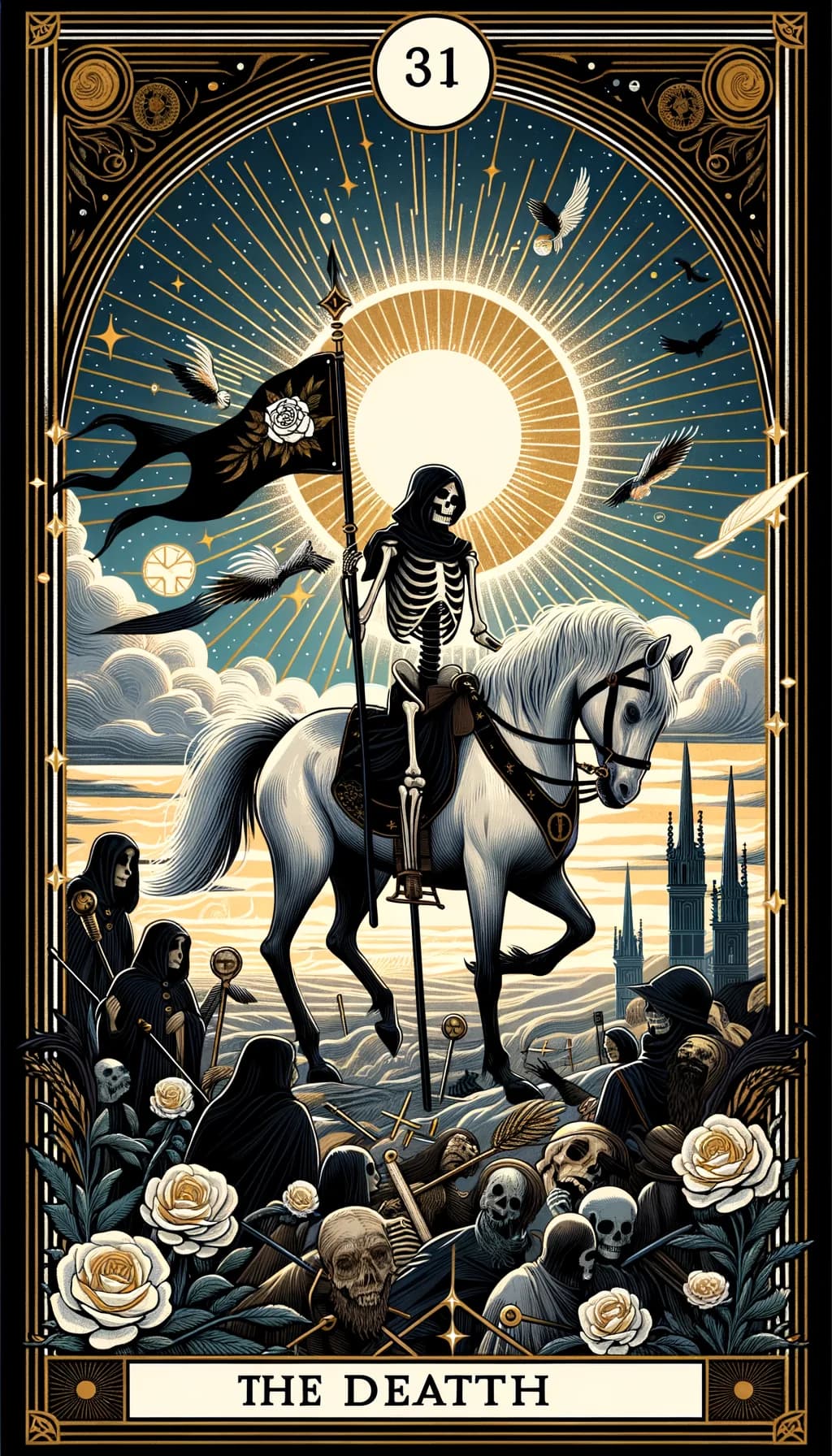
In the Rider-Waite-Smith deck, the thirteenth Major Arcana card depicts a skeleton clad in black armor astride a white horse, advancing across a field where a king already lies fallen, a bishop stands with hands clasped in prayer, a maiden turns away in reluctance, and a child offers flowers in innocent acceptance. This tableau is not random — Pamela Colman Smith painted four figures representing the four stages of human response to inevitable change: the ego already conquered, the spiritual self negotiating, the emotional self resisting, and the innocent self welcoming. The skeleton wears armor because Death is not fragile; it is the one force in nature that cannot be bargained with, bribed, or defeated. The black banner bearing a white five-petaled Tudor rose — the Mystic Rose of the Rosicrucian tradition — signals that life regenerates through dissolution, that the rose blooms precisely because organic matter decays. Behind the figures, a river flows toward two towers framing a setting or rising sun, echoing the pillars seen in The High Priestess and The Moon, suggesting passage between states of consciousness. Assigned to Scorpio and the element of Water, this card channels the fixed water sign's capacity for psychological depth, ruthless honesty, and regeneration through crisis. Waite himself insisted this card does not predict physical death — it depicts the metaphysical principle that identity, attachment, and form must periodically dissolve so that something truer can crystallize. When Death rides into your reading, it announces that a chapter has already ended; the only question is whether you will walk willingly through the gate or be dragged through it.
Symbolism & Imagery
overview
The skeleton beneath the armor represents what persists after everything impermanent has been stripped away — bone structure as metaphor for essential truth. The black armor signals invincibility; unlike the knight cards of the Minor Arcana, this rider cannot be unhorsed. The white horse, echoing the apocalyptic pale horse of Revelation 6:8, paradoxically symbolizes purity of purpose — transformation moves with clean intent, not malice. The fallen king wears a crown that has tumbled from his head, demonstrating that worldly authority offers no exemption from natural cycles. The bishop's mitre and vestments show that even spiritual authority must bow. The maiden's averted gaze captures emotional denial, while the child extending flowers represents the psyche's capacity to greet dissolution without fear — a direct reference to Christ's teaching about becoming as little children. The river in the background is the River Styx of Greek mythology and simultaneously the unconscious waters of Jungian psychology, carrying the dead toward rebirth. The twin towers recall Boaz and Jachin from Solomon's Temple, marking a threshold between known and unknown worlds. The sun hovering at the horizon refuses to clarify whether it rises or sets — Smith deliberately left this ambiguous because in the Death card's cosmology, endings and beginnings are the same event viewed from different angles. The number 13 itself carries weight: twelve represents completion (zodiac signs, apostles, months), so thirteen ruptures that completed order, creating necessary chaos from which new patterns organize.
Death Upright
Death upright does not whisper about change — it announces that something in your life has already died, whether you have formally acknowledged it or not. This card appears when a marriage has been emotionally over for months before divorce papers are filed, when a friendship has been sustained only by habit and guilt, when a career path stopped fitting years ago but inertia kept you walking it. The skeleton's forward motion on the card is relentless and calm; there is no negotiation scene depicted because negotiation is no longer available. Concrete scenarios where Death appears include: the aftermath of a medical diagnosis that restructures all your priorities, the moment you realize your children have grown and your identity as active parent is transforming, the collapse of a business that forces you to discover what you actually value about work, or the death of a belief system — religious, political, or personal — that had organized your entire worldview. What distinguishes Death from The Tower is intentionality: The Tower is sudden external destruction, while Death is organic completion, the way autumn is not a catastrophe but a season. The card demands honest inventory. What are you maintaining that has no life force left? What conversations are you avoiding because they would make an ending real? Death's gift is that it eliminates everything that isn't genuinely alive, leaving you with only what matters. The discomfort you feel is not the transformation itself — it is your grip loosening on something that was already gone.
Love & Relationships
In relationship readings, Death upright rarely means a breakup is coming — more precisely, it means the version of your relationship that existed is already gone. For couples, this manifests as concrete shifts: the honeymoon phase dying into something either deeper or hollow, the transition from childless couple to parents that obliterates your previous dynamic entirely, or the moment when one partner's personal growth makes the old relational contract obsolete. Couples who navigate Death successfully renegotiate their relationship from scratch rather than trying to resurrect what worked before. For singles, Death frequently signals the end of a romantic identity — the person who chased unavailable partners, the one who settled out of fear of loneliness, or the serial dater avoiding vulnerability. When that identity dies, the initial period feels like romantic emptiness, but it is actually a clearing. You stop attracting the same person in different bodies because you are no longer the same person sending out those signals. Death in love asks: can you grieve who you were together so you can discover who you might become?
Career & Work
Professionally, Death upright marks the end of a career identity rather than merely a job change. This card appears when a lawyer realizes they became an attorney for their parents' approval and the pretense has become unsustainable, when an entrepreneur's business model has been rendered obsolete by industry shifts they can no longer ignore, or when a long-tenured employee recognizes that company loyalty has become a prison of golden handcuffs. Death does not guarantee the next career will appear immediately — it guarantees that the current one is finished as a source of genuine engagement. Practically, this card often coincides with being laid off from a position you should have left voluntarily, having a mentor or professional relationship end, or watching an entire industry transform around you. The critical guidance is to avoid immediately replacing what died with its closest equivalent. A dead banking career reborn as another banking career is not transformation — it is reanimation. Death asks you to sit in professional uncertainty long enough to hear what actually wants to emerge.
Finances
Death in financial readings signals the collapse of a money paradigm, not necessarily money itself. This appears when inheritance follows a family member's passing, when divorce restructures household economics entirely, or when a financial strategy that worked for a decade suddenly fails because your life circumstances have fundamentally changed. The card advises against patching old financial structures. Instead, rebuild your relationship with money from your current reality, not from assumptions carried forward from a life stage that no longer exists.
Health
In health contexts, Death frequently accompanies diagnosis — the moment a condition is named and your self-concept shifts from 'healthy person' to 'person managing an illness.' This is not a prediction of terminal outcomes but an acknowledgment that your relationship with your body is being permanently restructured. Death also appears during menopause, post-surgical recovery, sobriety milestones, or any health event that divides your life into before and after. The card's counsel is to stop trying to return to your previous physical baseline and instead build a new relationship with the body you actually have now.
Spirituality
Spiritually, Death marks a profound initiation into deeper wisdom and authentic spiritual power. Your previous understanding of spirituality, religious beliefs, or metaphysical practices is undergoing complete transformation. This death of spiritual naivety births mystical wisdom earned through experience. You're moving beyond surface-level spiritual concepts into embodied understanding of life's deeper mysteries. Old spiritual identities, guru dependencies, or religious conditioning that limits your direct connection to the divine are being released. This transformation might feel disorienting as familiar spiritual anchors dissolve, but trust that what's emerging is a more authentic, personal relationship with the sacred. Your spiritual gifts are evolving, your intuitive abilities are heightening, and your understanding of your soul's purpose is becoming crystal clear.
Death Reversed
Death reversed does not simply mean 'resisting change' — it describes a specific psychological state that Jungian analysts call nigredo prolonged: the alchemical blackening phase that should be temporary has become a permanent residence. You are living in the decomposition stage without allowing the compost to become soil. Concretely, Death reversed appears when someone stays in a relationship for three more years after both partners privately acknowledged it was over, when grief becomes a fixed identity rather than a process, when you keep paying rent on an apartment in a city you moved away from because surrendering the lease makes the departure feel final, or when you maintain a deceased loved one's room exactly as they left it for years. The reversal does not indicate that transformation is unnecessary — it indicates that the death has already occurred but the burial has not. You are carrying something that is no longer alive and pretending the weight is normal. Sometimes Death reversed manifests as partial transformation: you changed jobs but brought every dysfunctional workplace habit with you, you left a toxic relationship but immediately recreated the same dynamic with someone new, you moved cities but rebuilt an identical life. The card challenges you to identify specifically what you refuse to release and honestly examine why. Often the attachment is not to the thing itself but to the identity you built around it. Releasing the dead thing means admitting you don't know who you are without it — and that unknowing is precisely what the reversal fears most.
Love & Relationships
Death reversed in love readings describes the relationship that has become a beautifully maintained corpse. Both partners may perform the rituals of coupledom — date nights, holiday photos, physical proximity — while privately knowing the emotional connection has flatlined. For singles, this reversal often indicates someone who has technically moved on from a past relationship but emotionally still lives there, comparing every new prospect to an idealized memory of someone who no longer exists as they remember them. This card also appears when someone repeatedly almost ends a relationship but retreats at the moment of decision, creating a cycle of near-breakups that exhausts both partners without resolving anything. The path forward requires naming what has died rather than performing resuscitation on something that has no pulse.
Career & Work
Death reversed professionally describes the worker who has mentally quit but physically remains — present in body, absent in engagement, collecting a paycheck while their professional development atrophies. It also appears when someone keeps reviving failed business ventures, refusing to accept market feedback, or when organizational restructuring has been announced but leadership delays implementation indefinitely, leaving employees in chronic uncertainty. The reversal asks whether your professional stagnation is truly about external barriers or whether you are using those barriers as permission to avoid the frightening freedom of genuine career reinvention.
Finances
Financially, reversed Death indicates resistance to changing money patterns that no longer serve you. You might be clinging to financial strategies, spending habits, or income sources that need transformation. Fear of financial insecurity keeps you trapped in unsustainable financial patterns. This card can also suggest incomplete financial transitions—starting budgets you don't maintain, beginning investment plans you abandon, or initiating debt reduction without following through. True financial transformation requires consistent commitment to new patterns.
Health
Health-wise, reversed Death suggests resistance to lifestyle changes essential for wellbeing. You might recognize what needs changing—diet, exercise, stress management, harmful habits—but struggle to implement lasting transformation. This resistance often stems from fear of discomfort, attachment to familiar patterns, or lack of confidence in your ability to change. The card encourages gentle but persistent effort toward healthier patterns, possibly with professional support to overcome resistance.
Death: Yes or No?
Death answers no to questions about preservation, continuation, and maintaining the status quo. If you are asking whether a situation will remain as it is, Death firmly denies that possibility. However, this no carries a crucial subtext: the ending it confirms is not punishment but prerequisite. If your question is reframed as 'Is this chapter finished?' the answer becomes an unambiguous yes. Death's no is the ground clearing that makes every future yes possible.
Death Combinations
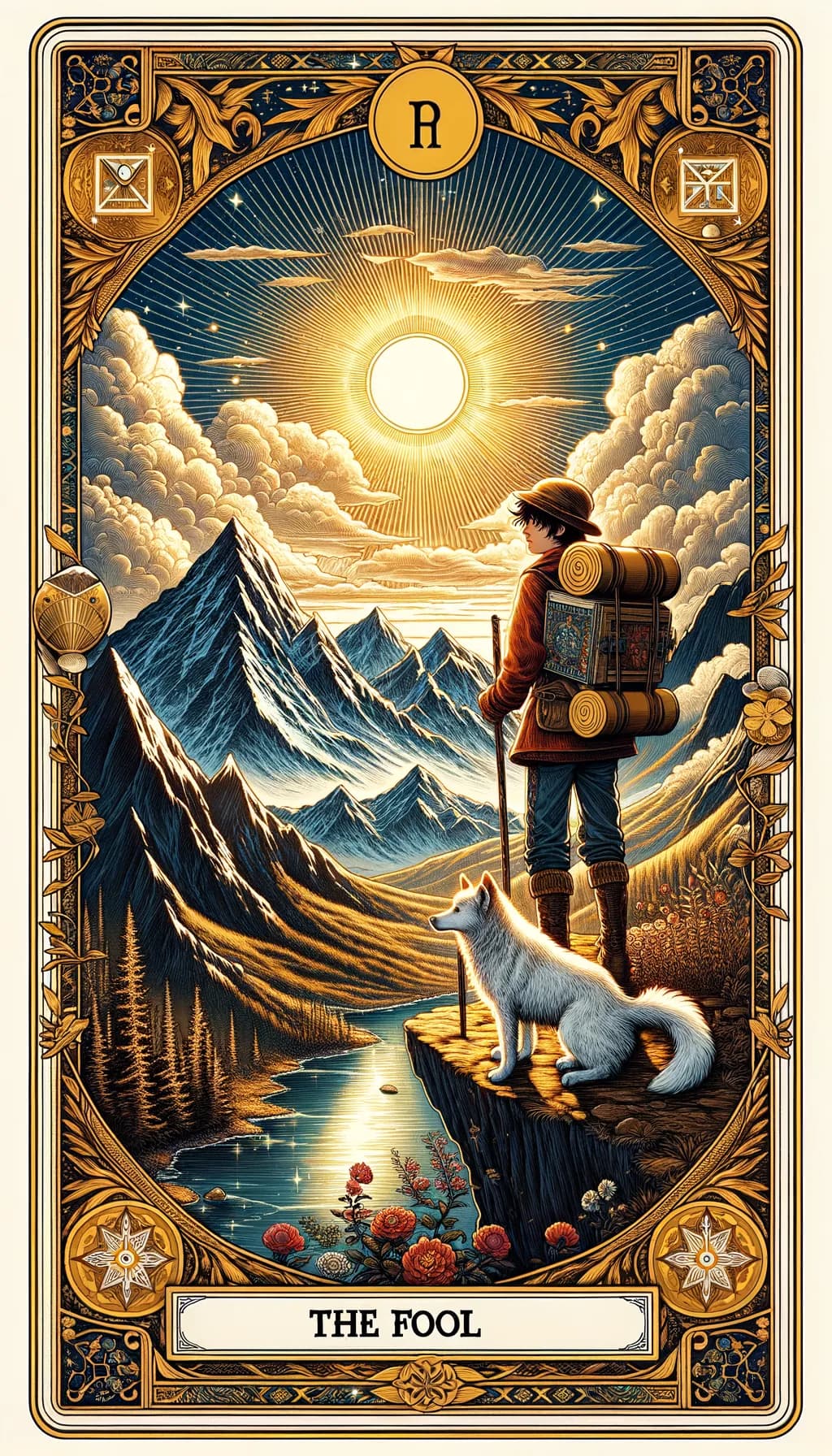
Death followed by The Fool is the tarot's most complete rebirth sequence. The old identity has fully dissolved, and you are stepping into genuinely unknown territory without the baggage of your former self. Unlike other new-beginning combinations, this pairing suggests you cannot plan your next chapter because the person who would have made those plans no longer exists. Trust the leap.
Read full combination →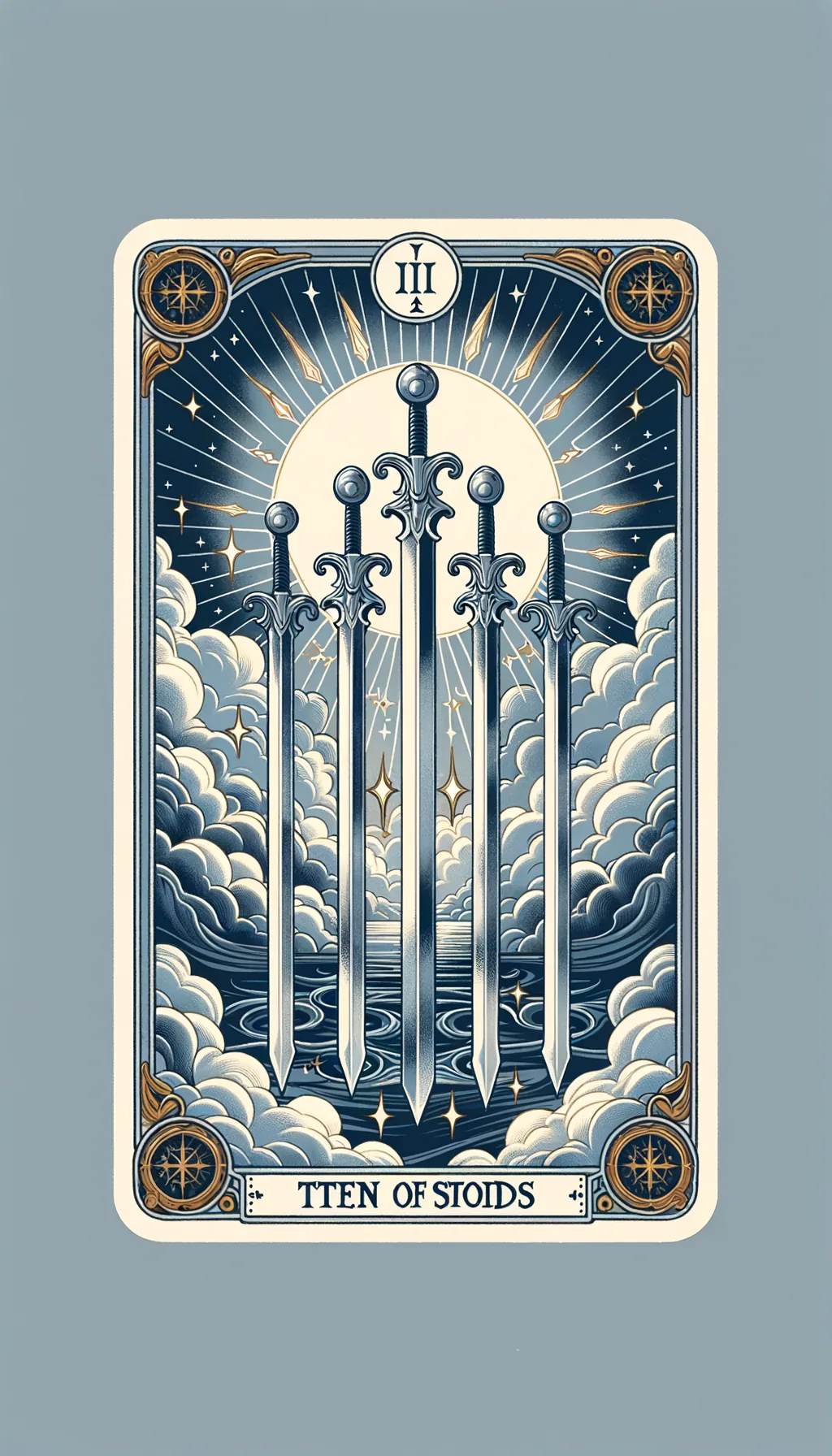
Death paired with the Ten of Swords indicates a dramatic, painful, and thoroughly complete ending — there is nothing left to salvage and no ambiguity about whether something is truly over. This combination often appears after betrayal, sudden loss, or the final collapse of a situation that endured many smaller wounds first. The mercy here is absolute finality: you are free because there is nothing left to cling to.
Read full combination →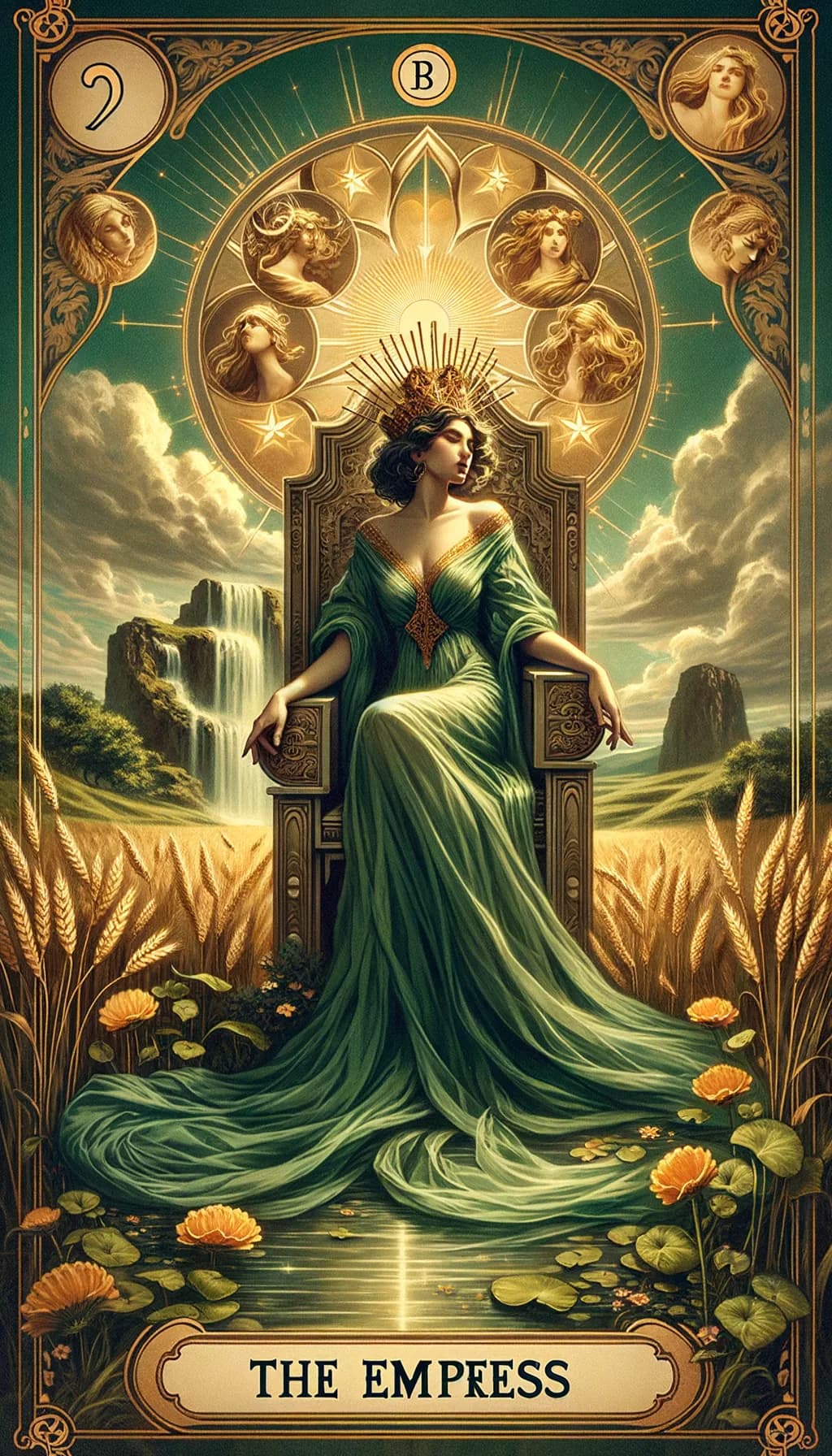
Death alongside The Empress channels Scorpio's connection to the reproductive cycle — something must die to feed new life, just as fallen leaves become the soil for next spring's growth. This pairing often appears around pregnancy after loss, creative projects born from grief, or the moment when nurturing energy redirects from what has ended toward what is germinating. Fertility follows the fallow period.
Read full combination →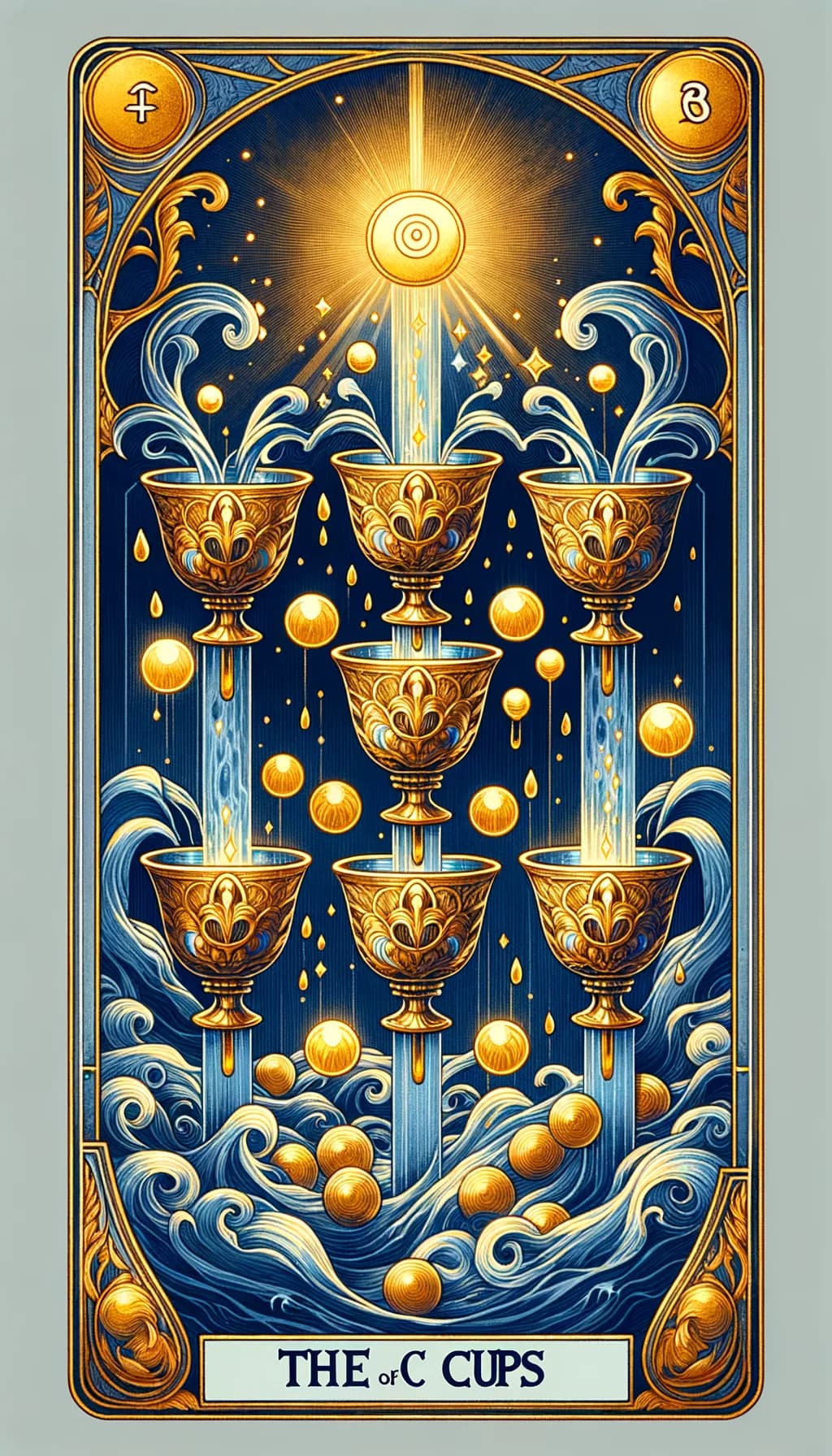
Death combined with the Five of Cups emphasizes that grief is the current work, not something to rush through toward rebirth. This pairing appears when the querent needs permission to mourn rather than immediately reframe their loss as growth. The two remaining upright cups in the Five remind you that something survives, but the card insists you honor what spilled before turning around to notice what remains.
Read full combination →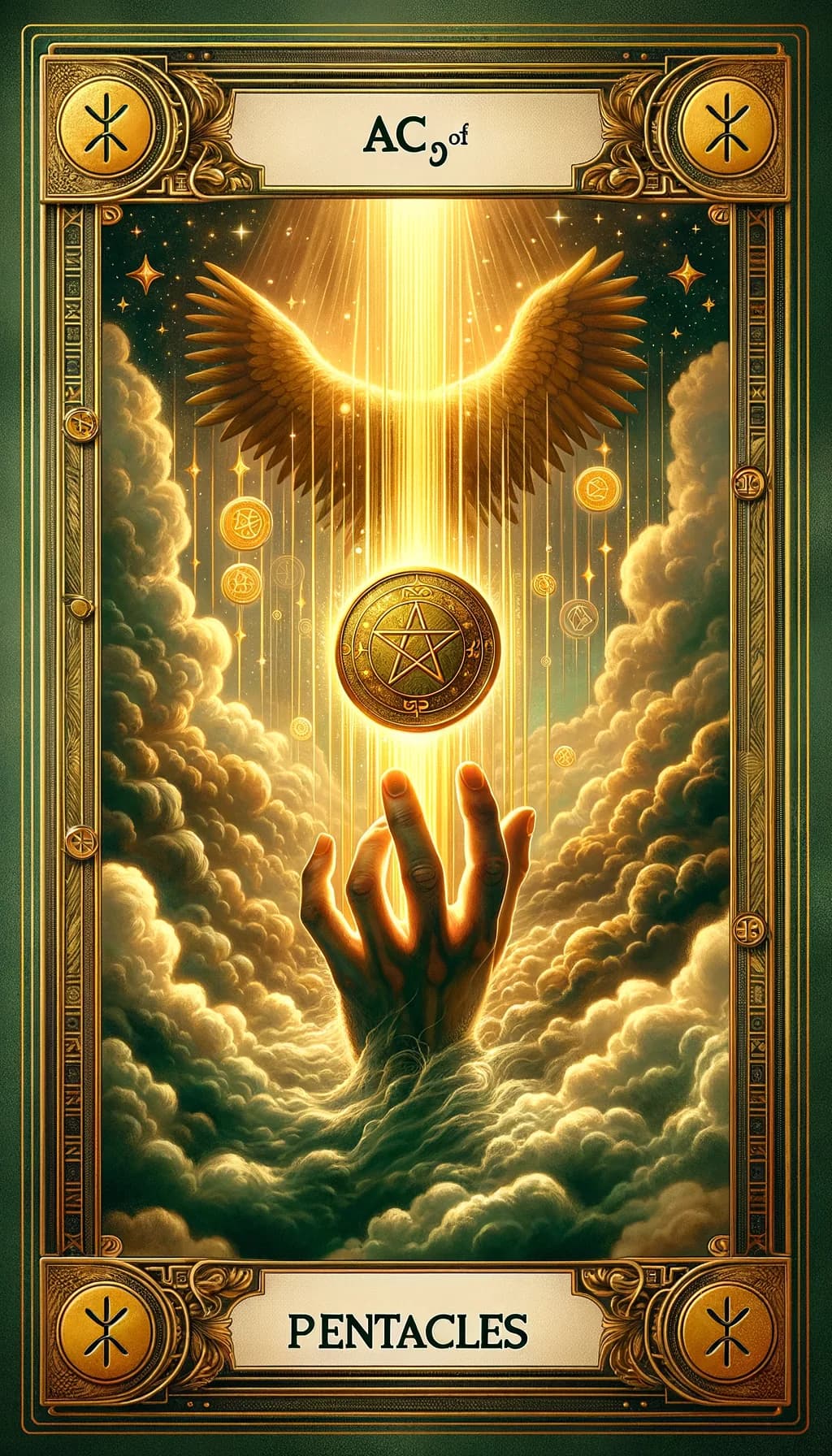
Death with the Ace of Pentacles signals that a concrete, material opportunity emerges directly from what has ended. This is the job offer that arrives after a layoff, the inheritance that follows a family death, or the physical space that opens when you finally clear out remnants of a former life. The Ace demands you actually grasp the opportunity rather than remaining in mourning for what made room for it.
Read full combination →Journal Prompts for Death
Write a eulogy for the version of yourself that existed one year ago — what did that person believe, value, and prioritize that you have already outgrown, and what do you want to formally thank them for before letting them go?
Identify one specific situation in your life that you privately know is over but publicly maintain — what exact fear keeps you performing its continuation, and what would the first 24 hours look like if you stopped?
Recall a past ending that felt devastating at the time but eventually created space for something you now cannot imagine living without — what pattern do you notice between that experience and what is currently dissolving in your life?
Reading Insights for Death
Card Advice
When Death appears in a spread, first identify what has already ended — not what might end, but what is functionally deceased even if still technically present. Ask the querent directly: 'What in your life do you already know is over but haven't fully acknowledged?' Death rarely predicts future events; it diagnoses present conditions. Positionally, Death in the past confirms a completed transformation that shapes the current situation. In the present, it marks the active dissolution phase. In the future position, it warns that something currently alive in the querent's life is approaching its natural conclusion. Pay close attention to surrounding cards for context: cards before Death show what is dying, cards after Death show what emerges. Never soften this card into generic 'transformation' platitudes — honor its weight by being specific about what is ending. If the querent fears physical death, address it directly: in centuries of documented tarot practice, this card consistently represents psychological, relational, or circumstantial endings, not mortality predictions. The most helpful reading acknowledges both the loss and the clearing simultaneously without rushing the querent toward silver linings they are not ready to see.
As an Outcome
As an outcome, Death promises profound transformation that completely aligns you with your authentic path. What emerges from this period of change will be more fulfilling, meaningful, and true to your soul's purpose.
Death as a Person
A Death personality embraces change as life's only constant, helping others navigate transitions with wisdom and grace. They understand that every ending births new possibilities and serve as guides for those facing their own transformative passages.
Draw Death in Your Reading
Ready to see how Death appears in context? Get a personalized AI-powered tarot reading now.